All Categories
Featured
Table of Contents
JPMorgan Chase is reportedly investing greatly in AI across its organization (including financing) as facilities, viewing it as vital rather than discretionary. Improving analytics platforms is a significant financial investment area.
The Deloitte and Fortune studies also mention substantial use of scenario planning and danger modeling (often AI-driven) to get ready for shocks. For instance, in Asia 54% of CFOs point out geopolitical danger as a top threat , a lot of are investing in systems to replicate "what-if" scenarios for cash flow and currency exposure.
Beyond AI, CFOs continue to deploy "dumb" and "smart" bots for rule-based tasks. Accounts payable, month-end close, reconciliations and compliance checks are significantly automated. The Deloitte CFO Signals note that about half of CFOs see automation as a method to "totally free workers for higher-value work" . Case in point: one CFO of a significant firm estimated an RPA ("copilot") can increase an overseas accountant's performance by 1.5 times versus an internal hire, thanks to incorporated AI tools .
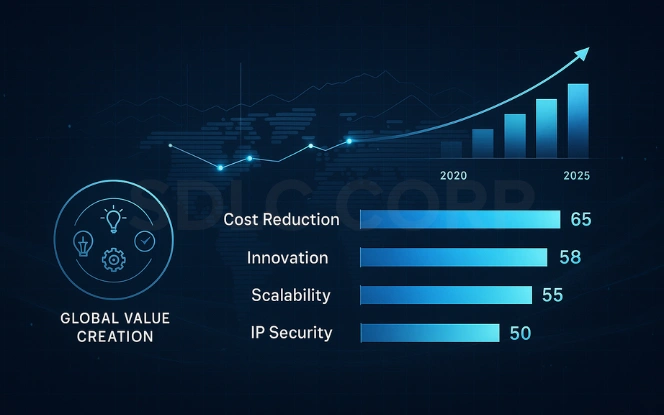
Lots of organizations are moving monetary systems to the cloud. The tech story at JPMorgan described earlier highlights a $17B international IT budget mostly targeted at modernizing facilities . Finance groups likewise are migrating legacy financing and accounting software application to cloud platforms. CFOs invest on cloud ERP (e.g. Workday, Oracle Cloud) and consolidated data lakes to break down silos.
Structuring Global Capability Center Strategies for 2026 Growth
CFOs evaluate that scaling on cloud helps lower system costs per transaction (the JPMorgan technique of measuring a "expense per transaction" instead of outright invest ), implying long-term savings justify the upfront financial investment. As finance systems digitize, so do related dangers. CFOs are enhancing spending on security, governance, and auditing tools.
Partially an expense center, robust security financial investments avoid possible multi-million-dollar losses from breaches. Similarly, CFOs buy regulatory compliance tools (for tax, reporting requirements, ESG data, and so on), seeing these as non-negotiable backstops that allow safe financial investment elsewhere. The information and automation revolution means that finance teams need brand-new abilities.
Another Deloitte finding was that many financing departments intend to ; in practice this indicates increase internal training programs so that existing personnel can fill advanced functions. Instead of working with brand-new MBAs at a premium, CFOs are reinvesting savings into internal movement and education (e.g. financial planning academy courses, accreditations in information science for financing).
Progressively, CFOs see ecological and social programs through the lens of expense optimization. Instead of just being a compliance expenditure, sustainable investments are expected to yield financial returns with time. For instance, according to PwC research study mentioned by a CFO commentator, dispersed energy performance projects (like modern-day cooling) can cut energy costs by .
provider ESG reporting) to identify win-win cost-reduction chances in the supply chain . In practical cases, government rewards (e.g. for EV charging infrastructure) are turning ESG jobs into successful investments. Therefore, investing in green innovations is often counted as both a future-facing technique and a cost optimization move. Taken together, these investments show a more comprehensive program: shifting from standard bookkeeping to positive analysis and worth generation.

Offshore Vs Nearshore Centers: a Strategic Review
As BCG notes, successful CFO-led improvements show trustworthiness and become models of effectiveness for the entire business . In practice, this suggests aligning cost-cutting with capability-building: CFOs cut tactical overhead however reallocate those resources towards analytical tools, information combination, and collective platforms. The outcome is a leaner, more agile financing team that can support service choices better.
Concurrently, growing projections accuracy (51%) and moneying new development opportunities (a cited top priority) included highly. A year earlier, an international "CFO Pulse" survey discovered over 70% of finance managers preparing to cut operating costs in 2025 yet a significant minority were increasing R&D/ IT budget plans . Internally, financing teams have reacted: one analysis discovered 67% of business were actively decreasing expenses in mid-2025, while nearly all kept AI spending plans undamaged .

Deloitte's CFO Signals (Jan 2026) indicates of CFOs name digital finance change as their # 1 top priority , which believe now is the correct time to take technological threat . In the exact same report, automation and AI metrics are striking: nearly 49% of CFOs stated automating regular jobs was their top talent goal, and a frustrating 87% expect AI to be essential .
Offshore Versus Traditional Offshoring in 2026Analyzing International Workforce Law Changes in 2026
SAP Concur research study showed a majority of CFOs preparing increased tech invest in 2025 for invest management). In the corporate arena, large companies are certainly budgeting greatly for finance IT JPMorgan, for instance, invested $17B on tech in 2024 and jobs more **. Quantitative arise from cost programs underscore the impact.

Latest Posts
Essential Corporate Growth Strategies for New Global Markets
Legal Best Strategies When Managing Offshore Work Laws
Should Enterprises Move to Nearshore Centers for 2026?