All Categories
Featured
Table of Contents
Nearshore sales groups are often an excellent fit for businesses that need real-time outreach and strong conversation quality. Teams in locations like Paraguay or Belize can adapt their tone to local markets and build trust more naturally in live calls. This model supports greater engagement and smoother handoffs, particularly for sales cycles that rely on relationship-building.
Eliminating Friction: Streamlining Handoffs Between Global TeamsThis model is especially reliable for producing interest at the top of the funnel.
Data and analytics outsourcing is when companies bring in outdoors teams to assist turn raw data into useful insights. This assistance permits internal teams to concentrate on technique while external partners handle the analysis required to guide daily choices. Nearshore analytics teams often work closely with customers to support reporting and forecasting.
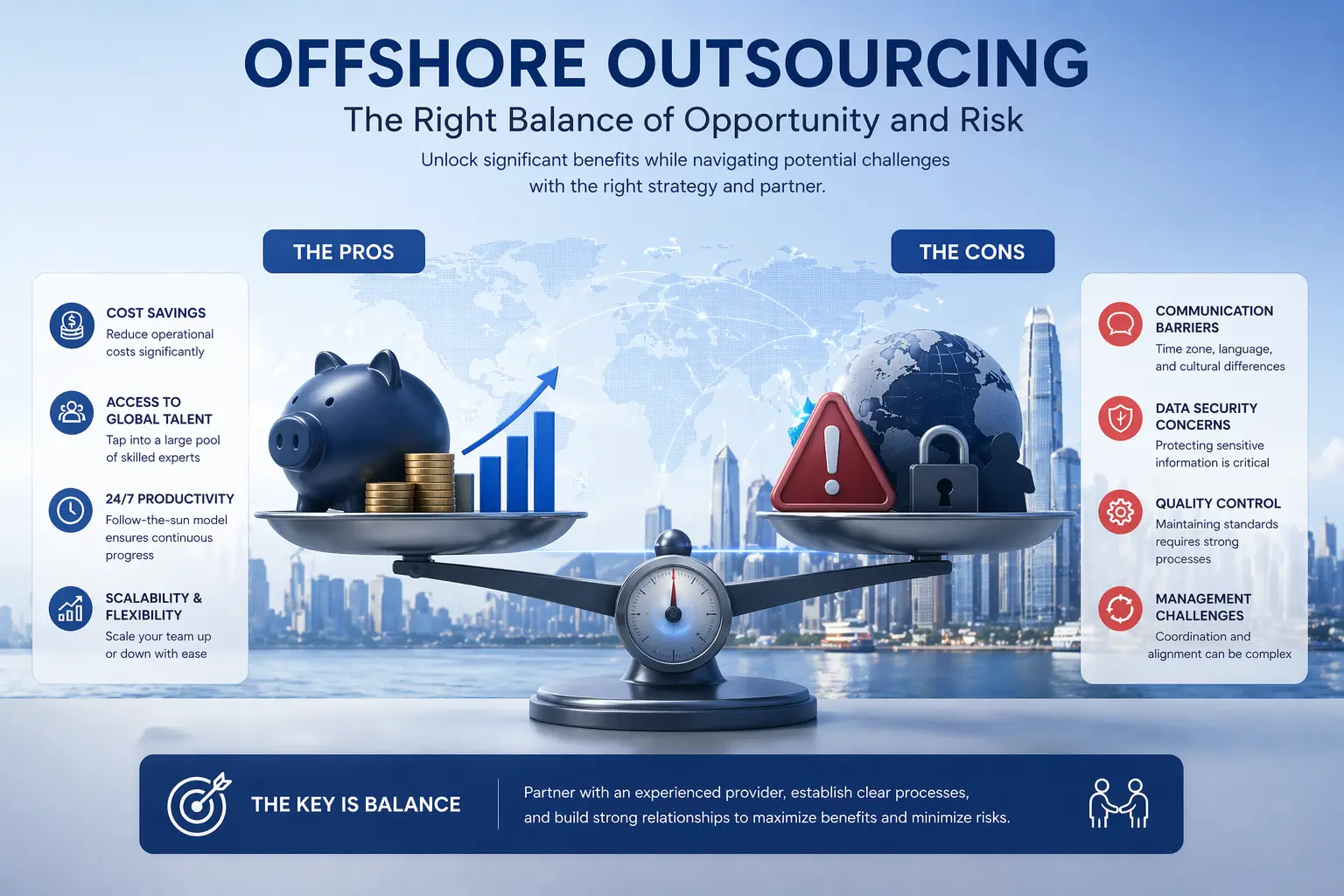
Analyzing Offshore Versus Hybrid Models for 2026
This makes it simpler to change dashboards or present findings without long hold-ups. While group sizes might be smaller sized, the close coordination assists organizations remain lined up as needs develop. Offshore analytics groups are well-suited for massive data processing and high-volume back-office tasks. Nations such as Kenya and Sri Lanka are developing strong capabilities in this area, providing cost-efficient support with quick turn-around times.
For jobs that need less back-and-forth, offshore outsourcing can provide speed and scale without overloading internal resources. Choosing the ideal outsourcing model depends on what your service needs most today. Some teams focus on speed and real-time communication, while others concentrate on cost savings or tapping into specialized skills. Your internal capability and job scope all play a function.
Time zone alignment makes it easier to fulfill to examine work and change quickly., go with offshore. It's the most affordable option when your group can manage postponed feedback or structured updates., stick with onshore. Working with a U.S.-based group makes coordination easier, especially for delicate or high-touch projects., outsourcing offshore or nearshore can help cover execution without growing headcount., offshore can scale quickly with a big skill pool and predictable costs., nearshore might be much better.
Select nearshore for faster models, offshore for structured, high-volume builds. A strong partner can help protect your intellectual home, decrease risk, and make sure your group is supported by the ideal individuals in the right locations.
Whether you're a start-up introducing quick or a recognized business prepared to scale, we assist you assess possible partners and make a positive choice on a partner you can trust. Our clients rely on us to advise contracting out business that regularly meet expectations.
Enhancing Corporate Output Via Custom GCC Solutions
As organizations continue to expand and globalize, the need for cost-efficient and effective advancement designs has ended up being increasingly essential. Three popular development designs that business often think about are nearshoring, offshoring, and onshoring. In this article, we will check out the differences between these designs and assist you choose which one is best for your service.
This cooperation service model was the first one which appeared on the development market when the technologies occur. Onshoring, likewise known as domestic sourcing, involves contracting out development to a company within the same country. This is generally done to keep higher control over the advancement procedure, reduce risks related to interaction and cultural distinctions, and assistance local services and communities.
It was the primary approach of production for many products in the nation till the mid-20th century. Nevertheless, the advent of globalization and the increase of offshoring and nearshoring caused a decline in onshoring in the latter half of the 20th century. Business began to move their manufacturing and production to nations with labour cost reduction and less policies, to increase earnings and have a competitive advantage.
Building a Global Capability Center Strategy for America
Many companies started to acknowledge the advantages of onshoring, such as shorter supply chains, better interaction and cooperation, and more control over the quality and consistency of their products in their own nation. Recently, onshoring has actually ended up being significantly popular as companies have faced obstacles in offshoring and nearshoring, such as increasing labour costs, supply chain disturbances, and geopolitical instability.
Brief Nearshoring HistoryThe history of nearshoring can be traced back to the early 1990s, when the North American Free Trade Agreement (NAFTA) was signed in between the United States, Canada, and Mexico. This contract developed a free trade zone between the 3 countries, that made it easier for business to outsource work to Mexico.
Companies in Western Europe started outsourcing work to countries in Eastern Europe, such as Poland, Romania, and Ukraine, which used lower costs and an extremely skilled labor force without language barriers and a best geographical place. Today, nearshoring is a popular option to offshoring, as it enables business to take advantage of lower labour costs while keeping closer cultural and linguistic ties to their home nation.
The goal is to achieve expense savings while increasing performance and performance.
making companies began outsourcing work to Japan, which was becoming a substantial commercial power at the time. This trend continued into the 1970s and 1980s, as U.S. business began outsourcing work to other countries in Asia, such as Taiwan, South Korea, and China. In the 1990s and 2000s, offshoring ended up being a lot more popular, as the internet and advances in communication innovation made it easier for business to outsource work to countries around the globe.
Should Enterprises Pivot Toward Nearshore Centers in 2026?
Today, offshoring stays a popular alternative for companies in many markets, such as manufacturing, software development, and customer support. It enables business to gain access to lower labour expenses and specialized abilities, while likewise providing opportunities for economic development in establishing countries. Some popular offshoring locations consist of India, China, the Philippines, and Western Europe.
Onshore, nearshore, and offshore are 3 different organization models for outsourcing work to external partners. They differ based upon the geography of the partner, ease and speed of collaboration, expense, and facilities. Here are the essential distinctions: Onshore outsourcing includes partnering business processes with a company in the same nation or neighboring town as the customer business.

Latest Posts
Essential Corporate Growth Strategies for New Global Markets
Legal Best Strategies When Managing Offshore Work Laws
Should Enterprises Move to Nearshore Centers for 2026?